Implementing OpenClaw in Swift and Vapor, part 1: telegram bot & Anthropic APIs
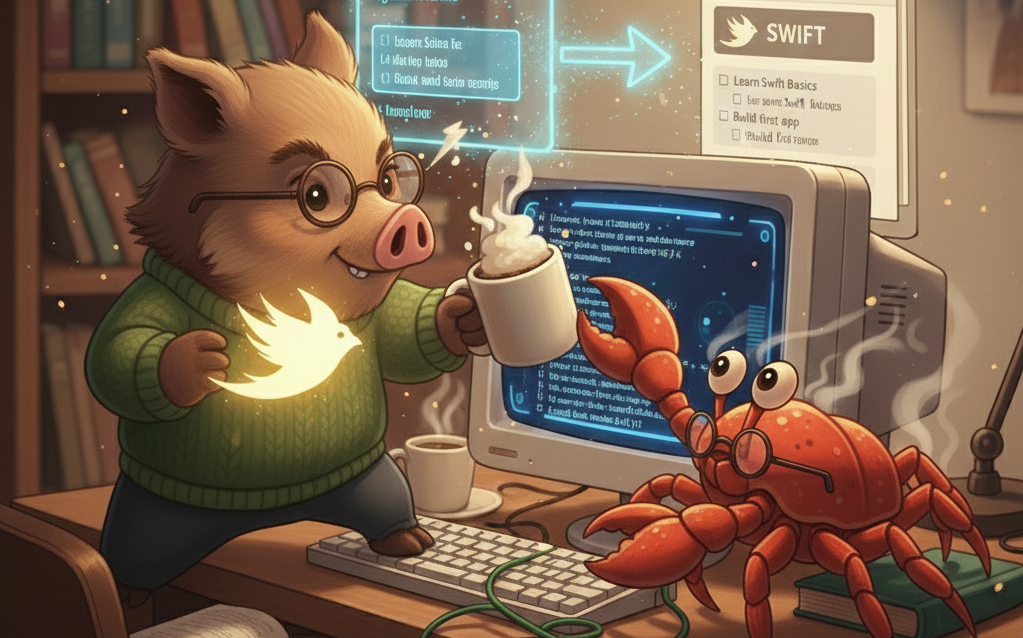
A lot (!) of people are talking about OpenClaw, but not many seem to know how it actually works under the hood.
Its core components, however, are surprisingly simple — and I think trying to reimplement it could be a good introduction for engineers to these new systems, as you end up learning a lot about orchestration, tool execution boundaries & safety, and where model prompts stop and system design starts.
Hence, I have been building my own version in Swift, using Vapor for the backend: diegopetrucci/claudio. The project is loosely based on this write-up by Dabit: How OpenClaw works.
I am also building this in a compartmentalized way so that, at (almost) any point, it can be run locally as a usable slice of the final system. I prefer this over trying to wire everything at once and only getting value at the end.
With that out of the way, let’s talk about the first tranche of changes:
- Setting up the Telegram bot interface
- Interfacing with Anthropic’s API from the Vapor backend
Scope-wise, this covers the code from the very first commit up to being able to send messages. That link lets you browse the repo at that exact moment in time.
As a note, I won’t cover how to set up Vapor. I’m not an expert, and their docs are great.
Telegram and Anthropic API prep
Go to Telegram, chat with the BotFather bot, and create your own. Write your ID in Vapor’s .env, make sure it’s ignored by git, and completely forget about it.
Do the same for Anthropic’s API key.
We are also using the SwiftAnthropic library to talk with Anthropic’s API.
Our starting point
Before adding memory, tools, or any autonomous loops, we want the minimum end-to-end path:
- Send the bot a message
- Receive a reply
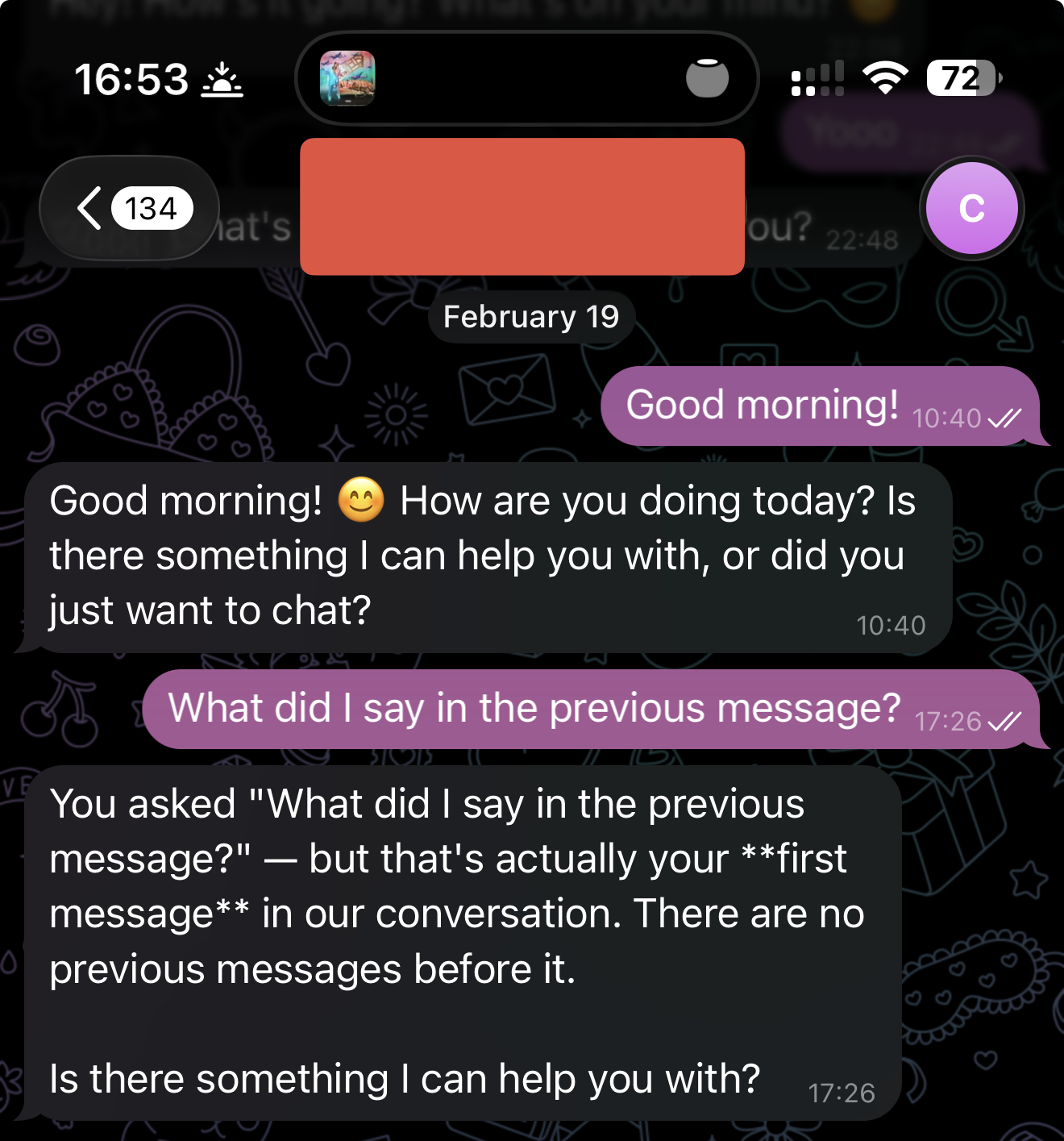
We are not concerned yet with any state persistence — each message will be a brand new “conversation:
The modules
The project is structured in a few Swift packages, and please note that we will ignore Docker for now:
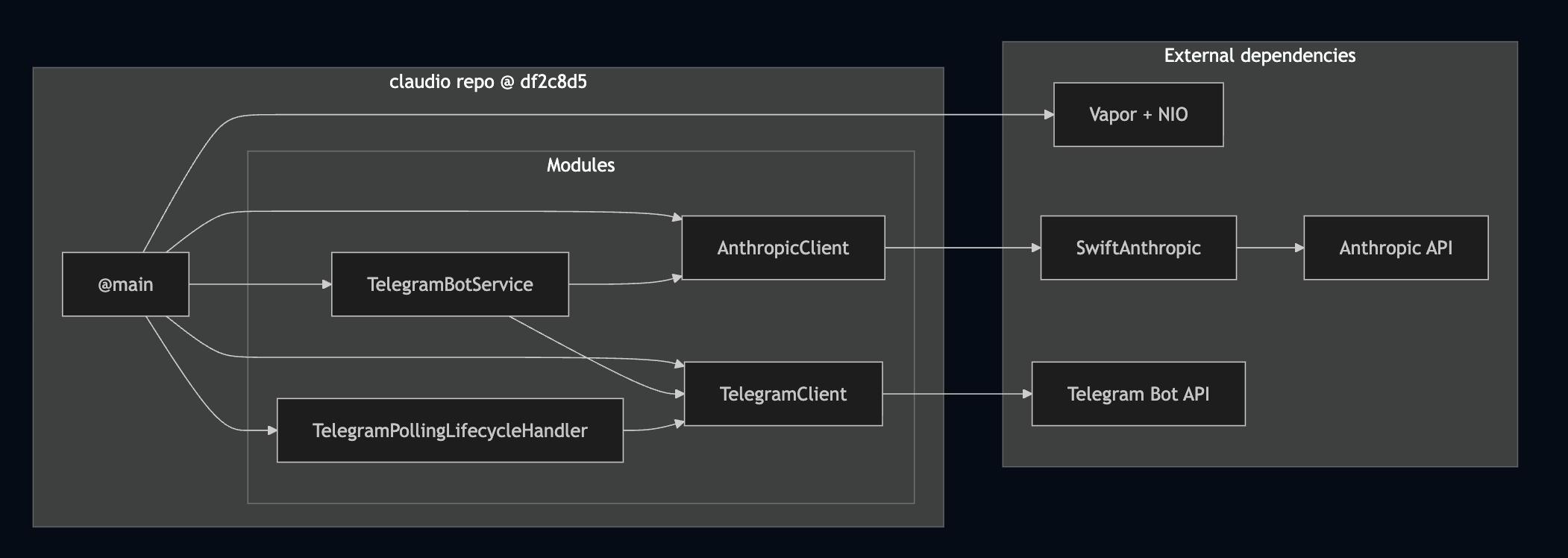
The architecture is quite simple:
- AnthropicClient: sets up the
AnthropicAPI call, sends it the user message, and receives a reply - TelegramClient: thin wrapper around Telegram’s
sendMessageandgetUpdatesAPIs - TelegramBotService: orchestrates bot behavior for incoming text: takes a Telegram message, asks Anthropic for a reply, then sends that reply back to Telegram
- TelegramPollingLifecycleHandler: where more of the magic lives, as it runs the long-polling loop as a Vapor lifecycle component. It continuously fetches updates from Telegram, filters/processes valid user text messages, invokes the bot service handler, and handles retry/cancellation/shutdown
Admittedly, TelegramPollingLifecycleHandler is already doing too much, but we will deal with that in the future.
What comes next
Memory! As mentioned, the bot at the moment has per-message amnesia, as it has no concept of a history or previous messages.
As a reminder, if you want to follow along, the code is in diegopetrucci/claudio and this post’s scope ends at commit df2c8d55dd20613ef8bc3c277e3b545d677b359f.
I did not start the project thinking of writing about it, so the first few commits are not semantically marked (the subsequent ones all have a prefix). But I’m sure you’ll get the gist.